Vertigo and Ménière’s disease can have a structural component rooted in the upper cervical spine – specifically misalignment at C1 and C2 – that standard medical evaluations often miss. Blair upper cervical chiropractic addresses that structural component directly, and many patients in Austin who’ve struggled with dizziness, spinning episodes, and ear fullness find meaningful improvement once the cervical piece is corrected.
Why Vertigo Keeps Coming Back When Nothing Seems to Help
If you’ve been managing vertigo with vestibular rehabilitation, antihistamines, or the Epley maneuver and the episodes keep returning, it’s worth asking whether the structural environment around the vestibular system has been evaluated. Most vertigo workups focus on the inner ear and the brain. Very few look at the upper cervical spine.
That’s a significant gap, because the anatomy connecting the upper cervical spine to balance and hearing function is well established. The problem isn’t that medicine doesn’t know about this connection – it’s that evaluating and correcting upper cervical misalignment requires specialized training and imaging that most providers don’t have.
The Anatomy Behind the Upper Cervical – Vestibular Connection
The atlas (C1) and axis (C2) sit at the base of the skull, adjacent to the brainstem. The brainstem houses the vestibular nuclei – the relay centers that process balance signals from the inner ear. When C1 or C2 shifts out of normal alignment, the resulting mechanical tension and postural change can affect vestibular nucleus function directly.
For Ménière’s disease specifically, there’s an additional mechanism. The eustachian tubes and inner ear drainage pathways are influenced by the surrounding musculature and fascial tension in the upper cervical region. Misalignment at C1 and C2 creates adaptive muscle tension that can compromise the drainage of endolymph fluid from the inner ear. When that fluid accumulates and pressure builds, the result is the classic Ménière’s triad – vertigo, tinnitus, and hearing fluctuation.
This doesn’t mean every case of Ménière’s or vertigo has a cervical cause. It means a significant portion do, and those cases are going unidentified and untreated at the structural level because the right evaluation isn’t being performed.
What Blair Analysis Reveals That Standard Imaging Misses
Standard MRI and CT imaging of the cervical spine is designed to identify fractures, disc herniations, stenosis, and significant structural damage. It is not designed to identify the smaller but clinically significant misalignments at C1 and C2 that the Blair technique addresses.
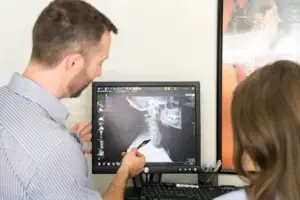
Blair X-rays are taken at specific angles that reveal the precise displacement of the atlas and axis relative to the skull and to each other. This analysis maps the direction and degree of misalignment in three dimensions – information that can’t be extracted from standard imaging and that is essential for delivering a precise correction.
Many patients with long-standing vertigo or Ménière’s symptoms have had cervical MRIs that came back “normal.” That result doesn’t rule out a Blair-relevant upper cervical subluxation. It rules out the gross pathology that standard imaging is designed to detect.
How Blair Upper Cervical Chiropractic Approaches Vertigo and Ménière’s in Austin
At Full Life Chiropractic, Dr. Newell’s evaluation for vertigo and Ménière’s patients begins with a detailed history – specifically looking at onset timing, any history of head or neck trauma, whether symptoms are influenced by head position, and what other treatments have been tried.
Upper cervical misalignment that contributes to vestibular symptoms often traces back to a specific injury event – a whiplash, a fall, a sports impact, or even a difficult birth. In many cases, the injury happened years before the vestibular symptoms appeared, which makes the connection easy to miss.
The Blair Correction Process
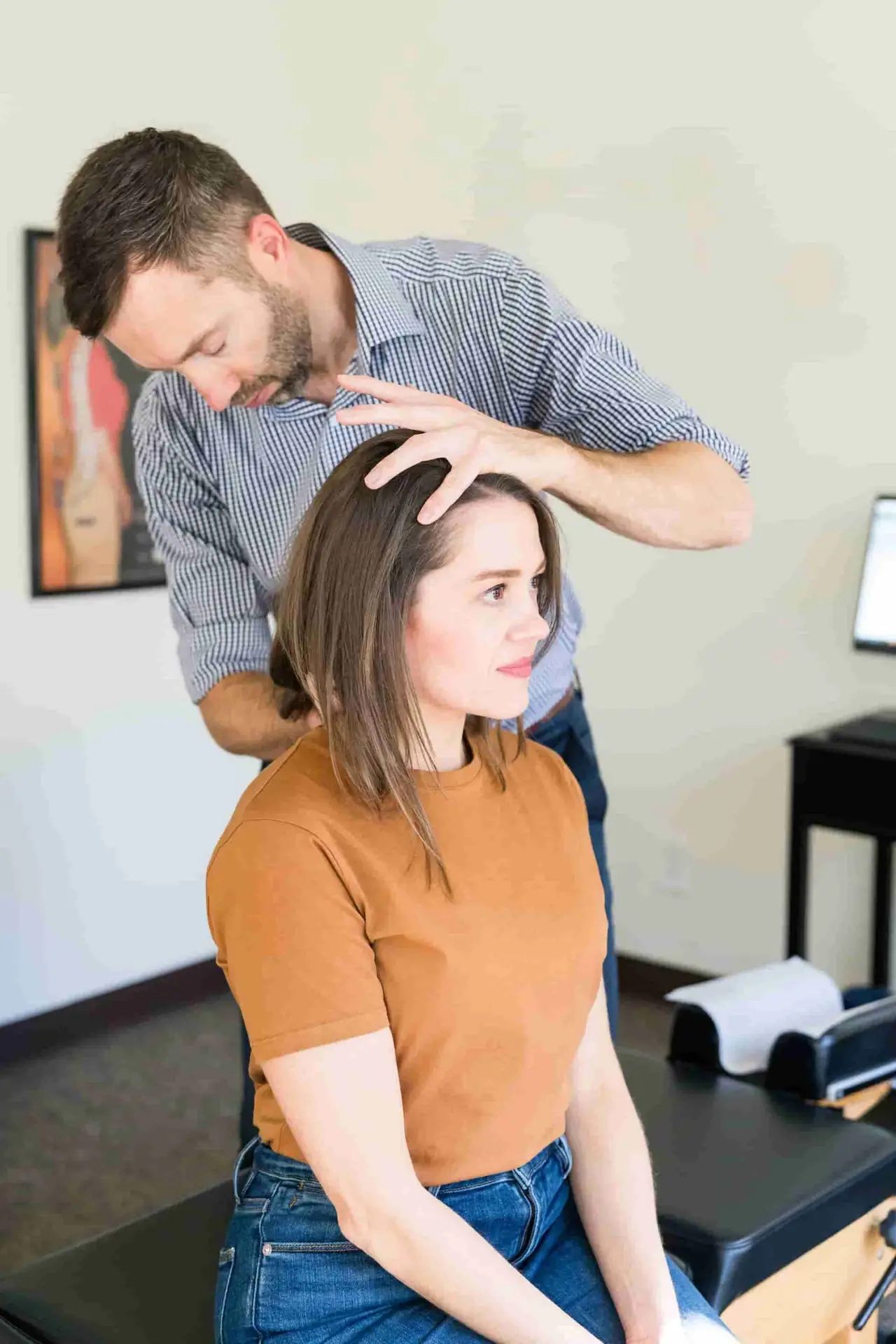
If Blair X-ray analysis confirms a significant upper cervical subluxation, the correction is delivered at the precise angle the analysis requires. No cracking, no twisting, no high-force thrust. The adjustment is low-force and targeted to the specific direction the atlas or axis needs to move based on that patient’s individual anatomy.
After the correction, Dr. Newell monitors progress using objective measurements to determine whether the alignment is holding. If it is, no further adjustment is made at that visit. The goal is a stable correction – not repeated manipulation that prevents the upper cervical structures from settling into improved position.
What Patients Can Realistically Expect
For vertigo and Ménière’s patients with a cervical structural component, improvement in episode frequency and intensity is the most common result. Some patients experience significant reduction in symptoms relatively quickly. Others see more gradual improvement over weeks as the nervous system adapts to improved alignment and the upper cervical structures stabilize.
Dr. Newell is careful not to overclaim here. Upper cervical chiropractic is not a cure for Ménière’s disease, and not every case has a significant cervical component. What he offers is a precise structural evaluation and, where a cervical component is identified, the most targeted conservative correction available.
When Vertigo Has a History of Trauma Behind It
One of the most consistent patterns Dr. Newell sees in vertigo and Ménière’s patients is a history of head or neck trauma – often from a car accident, fall, or sports injury that happened well before the vestibular symptoms began. The misalignment occurred at the time of injury. The vestibular consequences developed gradually as the nervous system compensated and then eventually decompensated.
This is a common presentation because C1 and C2 are the most mobile vertebrae in the spine and the most vulnerable to displacement from impact. A whiplash injury that “resolved” by standard medical standards may have left C1 or C2 in a slightly displaced position that was never corrected. Over time, that uncorrected displacement accumulates consequences.
If your vertigo or Ménière’s symptoms started or significantly worsened after an accident or injury, an auto injury evaluation that includes Blair upper cervical analysis is worth considering – even if the accident was years ago.
How This Differs from General Chiropractic for Vertigo
General chiropractic adjustments of the cervical spine are not the same as Blair upper cervical correction. A non-specific cervical adjustment may temporarily reduce muscle tension and improve mobility, but it doesn’t address the precise three-dimensional misalignment of the atlas and axis that Blair is designed to correct.
If you’ve had general chiropractic care for vertigo or dizziness without lasting results, that doesn’t mean upper cervical chiropractic can’t help. It means the right analysis and the right correction haven’t been applied yet. Blair certification is a specific qualification that requires training beyond standard chiropractic education – Dr. Newell is one of Austin’s only Blair-certified chiropractors.
Other Conditions That Often Present Alongside Vertigo
Upper cervical subluxation rarely causes just one symptom. Patients presenting with vertigo or Ménière’s symptoms at Full Life Chiropractic often also report chronic headaches or migraines, neck pain or stiffness, jaw tension or TMJ symptoms, or post-concussion symptoms. This overlap makes sense – all of these conditions share a common thread of upper cervical involvement, and a single structural correction can address multiple symptoms simultaneously.
Taking the First Step
If you’ve been dealing with recurring vertigo or Ménière’s symptoms in Austin and you haven’t had a Blair upper cervical evaluation, it’s worth having one. The examination will tell you honestly whether a cervical structural component is likely contributing to your symptoms – and if it is, what correcting it involves.
Schedule your evaluation online or call Full Life Chiropractic at 512-953-9612. We’re located at 3355 Bee Caves Rd #603 in Austin, TX 78746.