
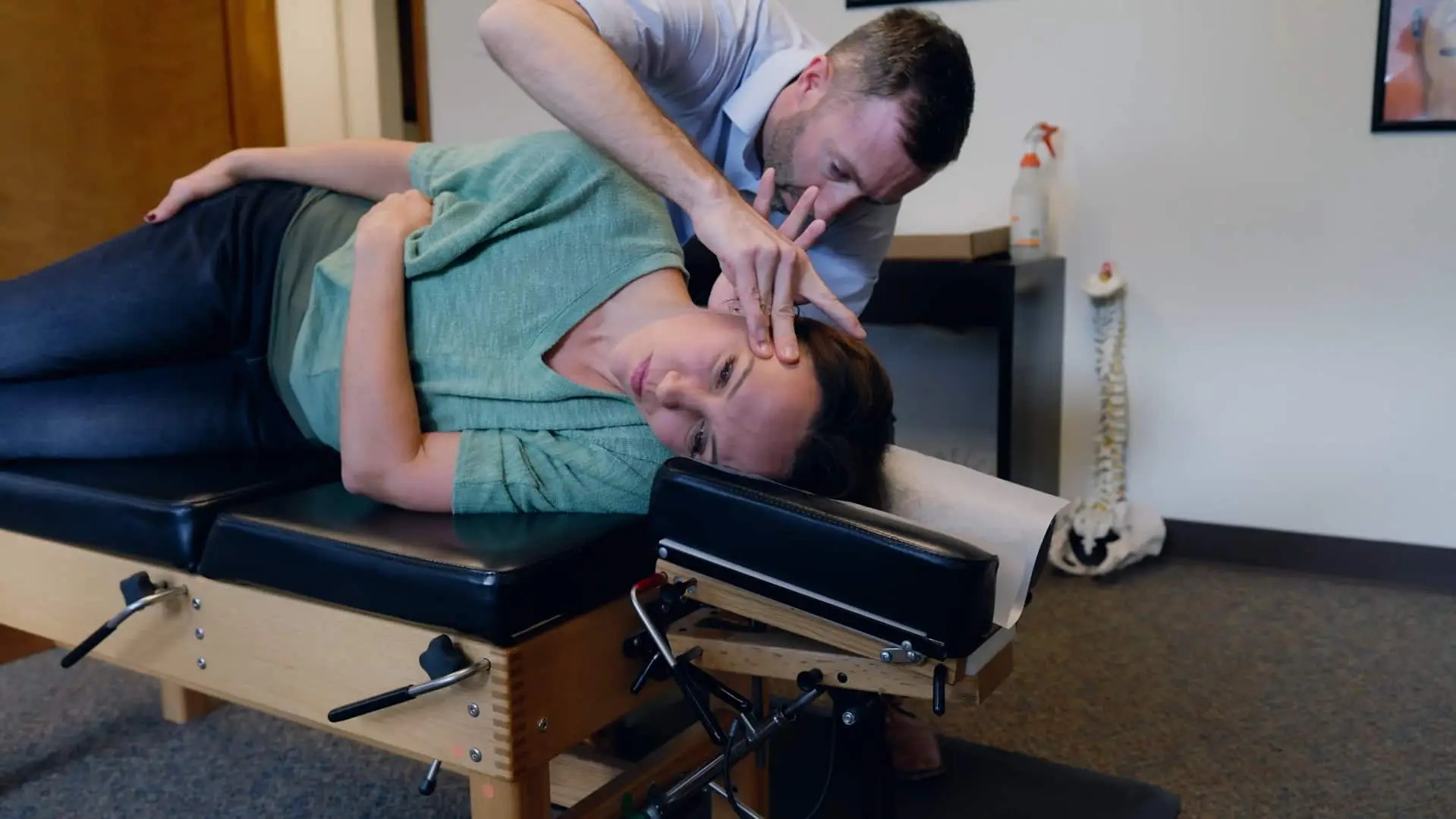
Blair chiropractic is a gentle upper cervical technique that focuses on the top two vertebrae in your neck: the atlas and the axis. Rather than relying on generic twisting or cracking, it uses a series of individualized X-rays to map your exact misalignment, then corrects it with a precise, low-force adjustment. Because these two bones sit directly next to the brainstem, restoring their alignment can influence far more than simple neck pain.
Where the Blair Technique Came From
The Blair technique was developed by Dr. William Blair and has been in use since 1949. It grew out of a straightforward observation: no two spines are built the same way, so no two adjustments should be identical.
That idea seems obvious, but it set Blair apart from the standard approach. Most chiropractic adjustments deliver force in a generalized direction. Blair takes the opposite path, treating each person’s anatomy as a one-off puzzle that has to be measured before anything gets corrected.
At Full Life Chiropractic in Austin, this is the foundation of how we work. Dr. Andrew Newell explored several upper cervical methods before committing to Blair, and he stayed with it for one reason: the results held up consistently in practice.
The Two Bones Blair Focuses On
Your atlas (C1) and axis (C2) are the top two vertebrae in your spine. They carry the weight of your head and let you nod and turn, but their real significance is what sits right beside them.
The brainstem passes through this region. It controls a remarkable amount of what your body does automatically, from blood pressure to balance to the constant stream of signals traveling between your brain and the rest of your body.
When C1 or C2 drift out of position, they can interfere with those signals. Sometimes that shows up as neck pain. Often it shows up as something that seems completely unrelated to the neck, which is exactly why so many people never trace their symptoms back to the upper cervical spine.
This area is also the most vulnerable part of the spine. The point where your head meets your neck is built for mobility rather than stability, which makes it easier to knock out of alignment than most people realize.
Why So Many People Have This Problem Without Knowing
Upper cervical misalignment is far more common than most people assume. It can come from a fall, a car accident, a sports impact, a concussion, or even the slow strain of years of poor posture.
Research cited by the Blair Chiropractic Association suggests that roughly 79 percent of people experience an upper cervical subluxation at some point. The reason most never address it is simple: they have never been examined by someone trained to look for it specifically.
That gap is what Blair is designed to close. The specialized imaging and analysis catch structural problems that a general exam, and even some standard scans, can miss entirely.
What Makes Blair Different From a Regular Adjustment
If you have seen a chiropractor before, your mental picture of an adjustment probably involves a quick twist and an audible pop. Blair does not work that way, and the differences are deliberate.
Your X-rays Come First
Every Blair patient receives a specialized X-ray series before a single correction is made. These images map the precise direction and degree of your misalignment.
That step matters because the angle of correction is calculated from your individual anatomy, not pulled from a standard template. Two people walking in with identical neck pain will almost never receive the same adjustment.
No Cracking, No Twisting
Blair corrections are low-force and precisely targeted. There is no high-velocity thrust, no wrenching of the neck, and no popping sound to chase.
For a lot of our Austin patients, that is the entire reason they walk through the door. Many tried traditional chiropractic and did not like being cracked, or felt nervous about it after an injury. A gentler, measured approach changes the experience completely. You can read more on our Blair upper cervical chiropractic page.
What a Blair Correction Actually Involves
The process is methodical by design. It begins with a detailed health history and a neurological exam so we understand what brought you in and what your nervous system is doing.
From there, the specialized X-ray series maps your atlas and axis. We analyze those images to determine the exact correction angle for your anatomy, then deliver a low-force adjustment on a specialized table built for this purpose.
What happens at your follow-up visits is the part most people do not expect.
Why “Holding” Matters More Than Visit Frequency
A Blair adjustment is only as valuable as how long it holds. At each follow-up, we take objective measurements to check whether your correction is staying in place.
If it is holding, we do not adjust you. That is worth repeating, because it runs against what most people have come to expect from chiropractic care.
The old model of coming in three times a week indefinitely is not how this works. The goal is to correct the underlying problem and let your body do what it is built to do, not to create a standing appointment that never ends. Our full thinking on this lives on our approach page.
Conditions That Often Have an Upper Cervical Component
Because the upper cervical spine sits so close to the brainstem, misalignment there can play a role in conditions that seem to have nothing to do with the neck.
In practice, we regularly see this pattern with headaches and migraines, neck pain, vertigo, TMJ, and post-concussion symptoms. None of these are guaranteed to resolve with care, and Blair is not a cure for any specific disease.
What the technique does is address a structural component that standard evaluations often miss. When that component is part of the picture, correcting it can make a meaningful difference in how someone feels and functions.
Does Blair Only Treat Neck Pain?
This is one of the most common questions we hear, and the answer tends to surprise people. While Blair starts at the neck, its effects are not limited to it.
The reason comes back to the brainstem. Because the atlas and axis sit so close to this control center, correcting their alignment can ease interference in the nervous system as a whole. That is why patients often report improvements in areas they never connected to their neck, including brain fog and balance.
None of this means Blair replaces other medical care, and it is not a fix for every problem. What it does is restore proper structure at a point where the entire body is affected, then let your nervous system work the way it is meant to.
Is Blair Chiropractic Right for You?
Blair tends to be a strong fit for people who have tried other care without lasting results, who are wary of aggressive techniques, or who are dealing with stubborn symptoms that no one has connected to the neck.
It is also a good match for anyone who wants to understand the mechanism behind their care. The whole approach is built on measurement and individual anatomy, which appeals to people who want to know why something works rather than simply being told that it does.
Not everyone is a candidate, and we will tell you honestly if that turns out to be the case. Finding out starts with a proper examination rather than a guess.
If you want to know whether Blair chiropractic is right for you, you can schedule your first visit online or call Full Life Chiropractic in Austin at 512-953-9612.