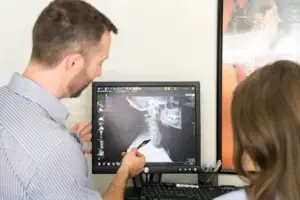

Blair chiropractic and traditional chiropractic are both called chiropractic, but the approach, the tools, and the experience are genuinely different. Blair uses individualized X-ray analysis to identify the exact misalignment at C1 and C2, then delivers a low-force correction at the precise angle your anatomy requires – no cracking, no twisting, no high-force thrust. Traditional chiropractic typically uses broader spinal manipulation across multiple levels with more generalized force. Understanding that difference helps explain why some patients find lasting relief with one and not the other.
The Most Common Chiropractic Experience – and Its Limitations
If you’ve been to a traditional chiropractor, you know the routine. You lie on a table, the doctor moves your spine through a series of adjustments, there’s cracking, and you leave feeling better for a day or two before the symptoms gradually return. You’re scheduled to come back three times a week, indefinitely.
There’s nothing dishonest about this model. Spinal manipulation can reduce pain and improve mobility. But if the underlying structural problem causing your symptoms hasn’t been identified and corrected, you’re managing symptoms rather than fixing anything. The relief is real. The resolution often isn’t.
That’s the pattern that brings many patients to Full Life Chiropractic in Austin. They’ve done chiropractic before. It helped temporarily. But the problem keeps coming back, and they’re starting to wonder if there’s a more permanent answer.
What Blair Chiropractic Is Built Around
The Blair technique was developed by Dr. William Blair in the late 1940s and has been continuously refined since. Its foundation is a single premise: the most critical area of the spine is the junction between the head and the neck, and corrections to that area must be based on each individual’s unique anatomy to be effective.
The atlas (C1) and axis (C2) sit at the base of the skull, adjacent to the brainstem. The brainstem controls virtually every automatic function in the body – breathing, heart rate, blood pressure, balance, and the relay of nerve signals between the brain and everything below it. When C1 or C2 shift out of their normal position, the interference that creates at the brainstem level can produce symptoms far beyond neck pain.
That structural problem – called an upper cervical subluxation – doesn’t always announce itself as neck pain. It can show up as chronic headaches or migraines, vertigo or Meniere’s symptoms, jaw pain, occipital neuralgia, brain fog, or a combination of things that seem unrelated until the cervical component is identified.
The Key Differences Between Blair and Traditional Chiropractic
Individual X-Ray Analysis Before Any Adjustment
Traditional chiropractic often uses standard X-rays for gross structural assessment, or none at all. Blair chiropractic uses a specialized series of X-rays taken at precise angles to map the exact misalignment of the atlas and axis relative to your individual joint anatomy.
This is important because joint angles vary significantly from person to person. The plane of the articulation between C1 and the skull, and between C1 and C2, is different in every patient. An adjustment that doesn’t account for your specific anatomy is essentially applying force in approximately the right direction – which is very different from precisely the right direction.
No Cracking or Twisting of the Neck
The cracking sound in traditional spinal manipulation comes from cavitation – gas releasing from the joint fluid under pressure. It’s not dangerous in itself, but the technique required to produce it involves a high-velocity thrust that moves the joint past its normal range of motion.
Blair adjustments don’t work that way. The correction is delivered at a specific angle with low force – precisely enough to move the misaligned vertebra toward its normal position without the thrust. There is no cracking sound because no cavitation is produced. For patients who are nervous about neck manipulation, this is a significant difference.
Adjustments Only When the Spine Needs One
In traditional chiropractic, adjustments are typically given at every visit as a matter of routine. The visit structure assumes that something needs to be done each time.
Blair works differently. At each visit, Dr. Newell takes objective measurements to determine whether the correction from the previous adjustment is still holding. If it is, no adjustment is made. The goal is to correct the misalignment once, let the body stabilize around that correction, and confirm that it’s maintained before considering another adjustment.
This approach produces corrections that last. It also means patients aren’t locked into a treatment schedule based on the calendar rather than their actual clinical status.
The Focus Is the Upper Cervical Spine – With Full-Spine Support
Traditional full-spine chiropractic addresses the entire spine at every visit. Blair’s primary focus is the upper two vertebrae because of their proximity to the brainstem and their role in the overall alignment of the spine below.
At Full Life Chiropractic, this doesn’t mean ignoring the rest of the spine. Dr. Newell uses Thompson Drop technique, CBP Mirror Image Adjusting, and Sacro-Occipital Technique alongside Blair to address full-spine issues. But the upper cervical correction comes first, because when C1 and C2 are properly aligned, the rest of the spine often self-corrects to a significant degree.
Why the Upper Cervical Region Is So Important
The Blair Chiropractic Association describes the point where the head connects to the neck as the weakest and most sensitive part of the spine. That’s not an overstatement. The atlas supports the full weight of the skull with very little bony stability – its structure is designed for range of motion, not for resistance to displacement. That’s why relatively minor forces – a car accident, a sports impact, a fall, even prolonged poor posture – can produce upper cervical subluxation that never fully resolves on its own.
What makes this clinically significant is the anatomy. The brainstem sits directly within the atlas. Cerebrospinal fluid circulates through the same space. The vertebral arteries pass through both C1 and C2. Misalignment at this level isn’t just a structural problem in the neck – it has the potential to affect neurological function throughout the entire body.
Most patients with upper cervical subluxation don’t know they have it. Standard medical exams don’t look for it. General chiropractic adjustments address it approximately at best. Specific Blair analysis identifies it precisely.
Who Benefits from Blair Rather Than Traditional Chiropractic
Blair is particularly well suited to patients who have had chiropractic care before without lasting results, patients dealing with neurological conditions like trigeminal neuralgia, post-concussion syndrome, or chronic neck pain with a postural component, and patients who have had accidents or injuries that were never fully resolved despite treatment.
It’s also the right choice for patients who want to understand what’s being done and why – because the X-ray analysis makes the structural problem visible and the correction trackable. This isn’t care you take on faith. You can see the problem, and you can measure the correction over time.
What Dr. Newell’s Training Involves
Blair certification isn’t an add-on course. It requires extensive training in radiographic positioning and analysis – learning to take and interpret the specialized X-rays that make precise Blair corrections possible. Dr. Newell completed that training before delivering his first Blair adjustment and attends Blair Chiropractic Association conferences annually to stay current with technique and research.
He’s one of Austin’s only Blair-certified chiropractors. That’s not a marketing line – it reflects how demanding the certification is and how few practitioners pursue it.
The Right Tool for the Right Problem
Traditional chiropractic is appropriate for many patients and many presentations. It’s not the wrong tool in every case. But for patients with upper cervical structural problems that are driving neurological symptoms, headaches, or recurring pain that doesn’t resolve, it’s often not specific enough to produce lasting change.
Blair upper cervical chiropractic addresses the precise structural cause. That’s the difference – not just in technique, but in outcome.
If you’re in Austin and you’re ready to find out whether upper cervical structural correction is the answer you’ve been missing, schedule a consultation online or call Full Life Chiropractic at 512-953-9612.