Herniated and Bulging Disc Injury Relief in Austin with Spinal Decompression
Whether you have been told you have a herniated disc, a bulging disc, or degenerative disc disease, Full Life Chiropractic in Austin offers non-surgical chiropractic and spinal decompression to address the problem at the source. Surgery is far less common than most patients expect when the mechanical cause is properly corrected.

Spinal Disc Pain Relief in Austin
Spinal discs are the shock absorbers between vertebrae, and when one bulges or herniates, it presses on nearby nerves and creates pain that often travels far from the disc itself. The deep, unrelenting ache that will not let you get comfortable in any position. The sharp pain that shoots down the leg when you shift in your chair. The numbness that woke you up at 3am.
A bulging disc extends beyond its normal boundary but remains intact. A herniated disc involves a tear in the outer layer allowing inner disc material to push through, typically causing more intense nerve compression and inflammation. Both conditions respond well to conservative care when the mechanical cause is properly addressed.
A bulging disc extends beyond its normal boundary but remains intact. A herniated disc involves a tear in the outer layer allowing inner disc material to push through, typically causing more intense nerve compression and inflammation. Both conditions respond well to conservative care when the mechanical cause is properly addressed.
- Deep low back or neck pain that does not fully ease with rest
- Pain that radiates into the leg or arm
- Numbness or tingling in the hands or feet
- Muscle weakness in the affected limb
- Pain that worsens with sitting, bending, coughing, or sneezing
What Causes Disc Injuries
Disc injuries rarely happen in a single moment. Most are the result of gradual wear combined with a triggering event.
- Age-related disc dehydration that makes discs more brittle and prone to tearing
- Prolonged sitting with poor posture, especially with a forward lean at a desk
- Repetitive bending, twisting, or heavy lifting
- A car accident, fall, or sports impact that put sudden force through the spine
- Years of compensating for an old injury that altered how load is distributed through the spine
- Weakness in the core muscles that support the spine, allowing discs to absorb more force than they should
How Full Life Chiropractic Treats Disc Injuries in Austin
Dr. Newell’s approach to disc injuries starts with identifying exactly which disc is involved, how severe the nerve compression is, and what caused it before any care begins.
Spinal Decompression
For disc injuries, spinal decompression is the primary treatment tool at Full Life Chiropractic. The Chattanooga Triton creates a controlled traction force that reduces intradiscal pressure, allows bulging or herniated material to retract toward the center of the disc, and promotes the flow of oxygen and nutrients back into the damaged tissue. Sessions are comfortable, most patients describe them as relaxing, and there is no downtime afterward.
Chiropractic Adjustments
Precise lumbar and cervical adjustments restore proper joint motion to the affected spinal levels, reducing the mechanical stress on the disc and the nerve irritation surrounding it. Thompson Drop and SOT techniques are used for lumbar disc cases. For cervical disc involvement, Blair upper cervical analysis identifies the exact levels and correction is delivered at the precise angle required.
Blair Upper Cervical Chiropractic
Upper cervical misalignment creates compensatory patterns throughout the spine that increase load on lumbar and cervical discs over time. Addressing C1 and C2 alignment removes that compensatory stress and supports the disc’s ability to heal and hold its correction.
What to Expect at Your First Disc Injury Visit
The first visit is a thorough evaluation designed to understand exactly which disc is involved and how severe the compression is.
- Health history and injury review focused on onset and symptom pattern
- Orthopedic and neurological testing specific to disc conditions
- Assessment of whether symptoms are lumbar or cervical in origin
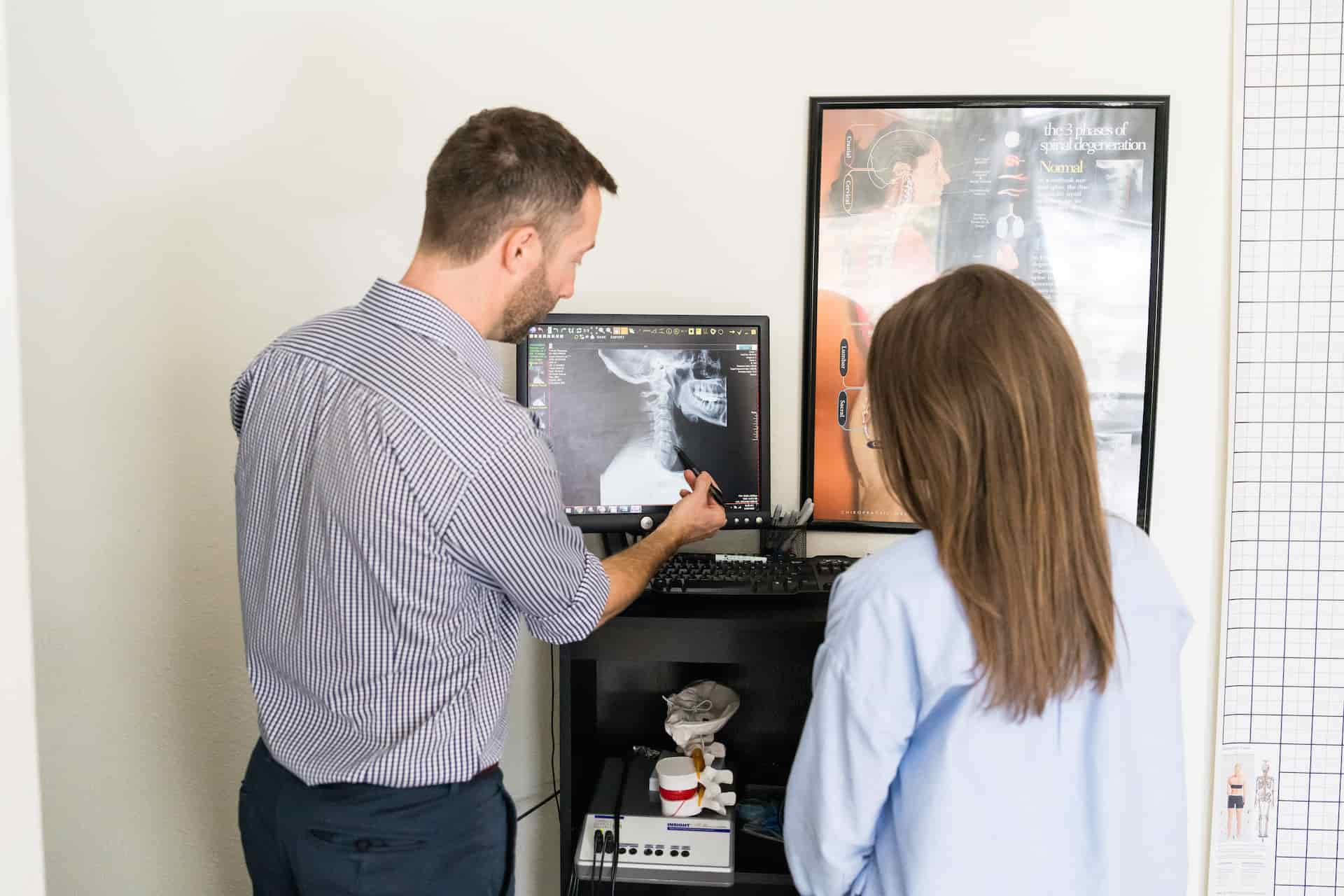
- Blair X-ray analysis where indicated
- Care plan presented at day three including whether decompression is appropriate
Most patients begin noticing meaningful improvement within the first several visits. Full recovery for disc conditions typically takes several weeks to months depending on severity and duration.
Non-Surgical Disc Care in Austin
The majority of herniated and bulging disc cases resolve with conservative care without surgery. Surgery becomes necessary in a small percentage of cases involving severe neurological compromise such as loss of bowel or bladder function or rapidly progressing weakness. For most patients experiencing pain, numbness, or sciatica from a disc, conservative care is both appropriate and effective.
- No hospital stay or recovery downtime
- No risk of surgical complications or failed back surgery syndrome
- Preserves the disc's natural structure and function
- Addresses the mechanical cause rather than just removing the symptomatic disc
Frequently Asked Questions About Disc Pain
Can chiropractic actually fix a herniated disc or does it just manage the pain?
Chiropractic combined with spinal decompression addresses the mechanical cause of disc compression, not just the symptoms. Research supports that conservative care including decompression can result in meaningful reduction or resolution of disc herniation over time, as the body reabsorbs disc material when the mechanical stress driving the problem is corrected.
What is the difference between a bulging disc and a herniated disc?
A bulging disc extends beyond its normal boundary but remains structurally intact. A herniated disc involves a tear in the outer fibers allowing inner disc material to push through. Herniation typically causes more acute nerve compression and inflammation. Both respond well to conservative care.
Do I need an MRI before starting treatment?
Not necessarily. Dr. Newell’s examination and X-ray analysis provide enough information to begin care in most cases. If the clinical picture suggests complex disc involvement or if symptoms are not responding as expected, an MRI referral may be recommended.
How long does disc pain take to get better with chiropractic care?
Acute disc injuries often show meaningful improvement within the first several visits. Chronic or longstanding disc conditions typically require a more structured multi-week plan. Full tissue healing takes longer than symptom resolution.
Is it safe to get adjusted if I have a herniated disc?
Yes, with appropriate technique. Dr. Newell uses low-force methods for disc cases and incorporates decompression rather than high-velocity lumbar manipulation where disc herniation is confirmed.
When is surgery actually necessary for a disc problem?
Surgery is indicated for disc cases involving severe progressive neurological compromise, loss of bowel or bladder function, or foot drop that does not respond to conservative care. For the vast majority of disc patients, conservative care is the appropriate first approach.
Ready to Get Relief from Disc Pain in Austin?
Full Life Chiropractic is located at 3355 Bee Caves Rd #603, Austin, TX 78746. Dr. Newell sees new patients outside of standard adjusting hours.