
A stiff neck from sleeping wrong or stress usually eases within a few days and feels better as you move. Whiplash comes from a sudden force, often a car accident, and tends to bring delayed pain, headaches, dizziness, and stiffness that lingers or even worsens over the following days. The biggest difference is what is happening underneath the surface: whiplash can cause a genuine misalignment of the upper neck that a standard emergency room scan will not catch.
What a Regular Stiff Neck Feels Like
An everyday stiff neck is something most people have dealt with. You wake up with a sore, tight neck, or it creeps in after a long day hunched over a screen.
It is annoying but usually predictable. The discomfort tends to stay in the neck and shoulders, it eases when you gently move and stretch, and it fades on its own within a few days.
This kind of stiffness comes from muscle tension or a minor strain. There is no major force involved, and there is rarely anything structurally wrong underneath.
What Whiplash Actually Is
Whiplash is a different category of injury entirely. It happens when your head is thrown rapidly forward and back, or side to side, faster than your neck is built to handle.
That sudden whip motion can stretch and tear soft tissue, but it can also shift the alignment of the vertebrae in your upper neck. Car accidents are the most common cause, though falls and sports impacts can produce the same effect.
The tricky part is timing. Whiplash symptoms often do not appear right away. Adrenaline and shock can mask the injury for hours or even a day or two, which is why people walk away from a crash feeling fine and wake up the next morning barely able to turn their head.
Whiplash vs. Stiff Neck: The Signs That Set Them Apart
If you are trying to figure out which one you are dealing with, these differences are the clearest signals:
- The trigger: A stiff neck has no real cause or comes from posture and sleep. Whiplash follows a specific impact or collision.
- The timeline: A stiff neck appears right away and improves daily. Whiplash pain is often delayed and can worsen over the first few days.
- The symptoms: A stiff neck stays local. Whiplash can bring headaches, dizziness, jaw pain, arm tingling, brain fog, and trouble concentrating.
- The recovery: A stiff neck resolves in days. Whiplash can linger for weeks or months when the underlying misalignment goes unaddressed.
If your symptoms followed a crash and reach beyond simple neck soreness, you are most likely dealing with more than a stiff neck.
Why Low-Speed Crashes Still Cause Real Injury
A lot of people assume that a minor fender bender cannot do much damage. The car was barely dented, so the body must be fine. That assumption leaves a lot of injuries untreated.
The forces involved in even a low-speed collision are enough to whip the head and neck well beyond their normal range. Your vehicle absorbs some of the impact, but your neck absorbs the rest.
Crash testing has shown that even impacts under 10 miles per hour can generate forces well beyond what the neck comfortably tolerates. The human body did not evolve to absorb a sudden jolt from behind, no matter how minor the dent looks.
We regularly see patients in Austin whose cars looked almost untouched but who developed significant neck problems afterward. The condition of the bumper says very little about the condition of your spine.
What the ER Scan Misses
After a serious accident, an emergency room visit is the right call, and ER imaging is excellent at what it is designed to do. It rules out fractures, bleeding, and other immediate dangers.
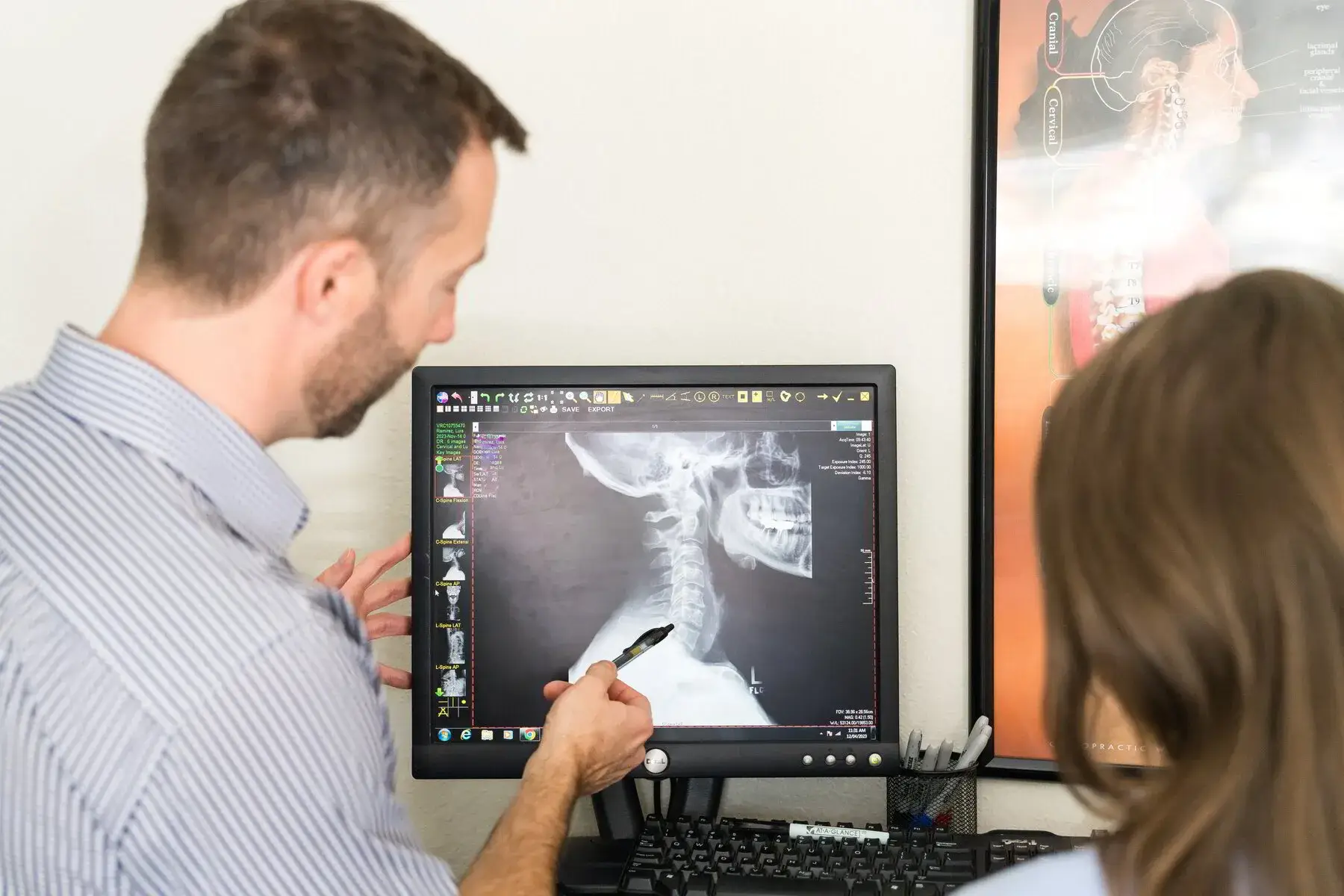
What it is not designed to detect is the kind of subtle upper cervical misalignment that whiplash commonly produces. A scan can show that nothing is broken while completely missing that your atlas or axis has shifted.
Standard imaging is built to answer one urgent question: is there anything life-threatening here? It is not meant to assess the precise positioning of the upper cervical vertebrae, which calls for a different type of analysis altogether.
That gap is why so many people are told everything looks fine, yet keep struggling with headaches, dizziness, and neck pain for weeks afterward. The injury is real, it simply does not appear on the type of imaging that was used.
Whiplash Symptoms People Tend to Overlook
Neck pain and stiffness are the obvious signs, but whiplash often shows up in ways people never link to a car accident. Recognizing them early can save months of frustration.
Headaches that start at the base of the skull are common, as are dizziness and a vague sense of being off balance. Some people develop jaw pain, ringing in the ears, blurred vision, or a foggy feeling that makes it hard to concentrate.
Sleep problems, irritability, and fatigue can follow too. When these symptoms appear in the days or weeks after a crash, the neck is a likely culprit even if it does not hurt much on its own.
What Happens If Whiplash Goes Untreated
Whiplash does not always heal on its own, and ignoring it can carry a cost. When an upper cervical misalignment lingers, the surrounding muscles and ligaments adapt around the problem, which can lock it in place.
Over time, that can lead to chronic neck pain, recurring headaches, and reduced range of motion that becomes harder to reverse the longer it sits. What might have been a straightforward correction early on can turn into a much longer road.
This is the main reason we encourage anyone involved in a collision to get checked promptly, even when the discomfort seems minor at first.
How Upper Cervical Care Helps After an Accident
This is where Blair upper cervical analysis becomes especially useful. Whiplash so often involves the C1 and C2 vertebrae, the exact area the technique is built to evaluate and correct.
At Full Life Chiropractic, we use specialized imaging to map any misalignment, then make a precise, low-force correction. There is no aggressive cracking or twisting, which matters a great deal when you are already in pain.
We also handle the thorough documentation that auto injury cases require for insurance companies and attorneys. Most Austin auto accident patients pay nothing out of pocket while their claim is active, which you can read about on our auto injury and personal injury care page.
Don’t Wait to Get Checked
Because whiplash symptoms can be delayed, the smartest move after any accident is to get evaluated even if you feel okay. Catching a misalignment early is far easier than untangling months of compensation and chronic pain.
If you walked away from a crash feeling fine, that is good news, but it is not the same as confirming you were not injured. A proper upper cervical exam answers that question clearly.
An evaluation asks very little of you, and it can be the difference between a quick recovery and a problem that lingers for months.