Low back pain does not always start in the low back. The top two vertebrae in your neck set the foundation for how your entire spine aligns, and when they shift, your body compensates all the way down. That compensation can distort your posture and load your lower back unevenly, which is why some stubborn low back pain only improves once the upper neck is addressed.
Why the Source of Pain Isn’t Always the Site of Pain
It feels logical to treat pain exactly where you feel it. If your low back hurts, the low back must be the problem. Often that is true, but not always.
The spine is a connected system, not a stack of independent parts. A problem at one end can create strain at the other, and the place that hurts is sometimes just where the strain finally shows up.
This is why people can chase low back pain for years, treating the symptom over and over, without lasting relief. The site of the pain was never the true source.
How the Upper Neck Affects the Whole Spine
Your atlas and axis sit at the very top of the spine, right beneath the skull. They carry the weight of your head and help set the position of everything below them.
When these vertebrae are aligned, your head sits balanced over your spine and the load distributes evenly. When they shift, your head tilts slightly off center, even by a small amount.
Your body will not let you walk around tilted, so it compensates. Muscles tighten, your shoulders and hips adjust, and your spine curves to keep your eyes level. All of that compensation has to go somewhere, and the low back often absorbs a large share of it.
The Compensation Chain, Step by Step
It helps to picture how a small misalignment up top ripples downward. The process is gradual, which is part of why it goes unnoticed.
First, the upper cervical shift moves the head slightly off center. Next, the muscles along the spine tighten unevenly to rebalance you. Then the mid-back and pelvis adjust their position to compensate.
Finally, the low back ends up carrying an uneven load day after day. Over months and years, that steady, lopsided stress can produce exactly the kind of aching, recurring low back pain that never quite resolves with local treatment.
What makes this so easy to miss is that none of it hurts at first. The compensation happens quietly for a long time, and by the time the low back finally complains, the original misalignment up top is the last place anyone thinks to look.
Common Causes of Upper Cervical Misalignment
If the top of your spine can influence your low back, it helps to know what knocks it out of alignment in the first place. The causes are more common than most people expect.
Falls, car accidents, and sports impacts are frequent culprits, since the upper neck absorbs so much force. So can old injuries you may have forgotten, along with the slow strain of years of poor posture at a desk or on a phone.
Even a single significant event years ago can leave a misalignment that quietly shapes how the rest of your spine loads itself every day since.
Signs Your Low Back Pain Might Have an Upper Cervical Component
Not all low back pain traces upward, but a few patterns hint that the neck could be involved.
Pain that keeps returning after treatment aimed only at the low back is one clue. Uneven posture, such as one shoulder or hip sitting higher than the other, is another. A history of head or neck trauma, or low back pain alongside headaches and neck stiffness, also raises the possibility.
If any of that sounds familiar, it may be worth looking higher up the chain than the spot that hurts.
None of these signs is proof on its own. Together, though, they build a picture that points toward checking the upper cervical spine rather than treating the low back in isolation one more time.
How We Approach Low Back Pain Differently
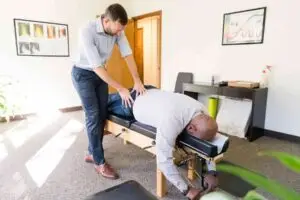
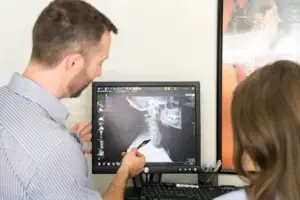
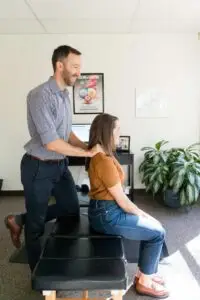
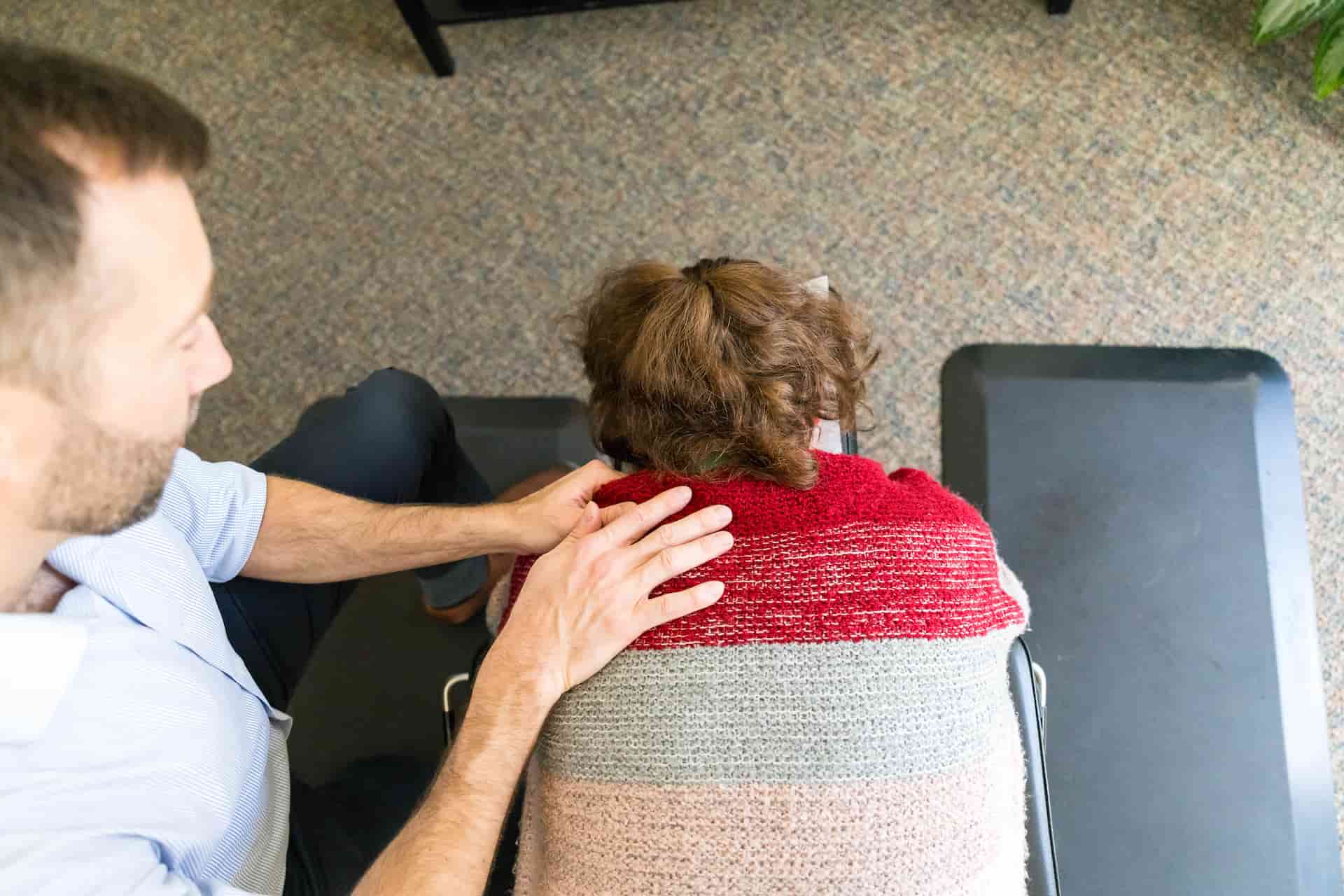
At Full Life Chiropractic in Austin, we start by looking at the whole spine rather than just the painful area. That begins with assessing whether your upper cervical spine is aligned, since it sets the foundation for everything below.
Blair is the cornerstone of that work, but it is not the only tool. We also use full-spine techniques like Thompson Drop, CBP mirror image adjusting, and Sacro-Occipital Technique to address the rest of the spine where needed. You can read more on our Blair upper cervical chiropractic page.
The aim is to correct the underlying structural pattern, not just to chase the ache. When the foundation is level, the compensation downstream often eases on its own.
When Low Back Pain Needs Direct Attention
The upper neck is not the answer to every case, and we are honest about that. Plenty of low back pain comes from local causes like a disc problem, a muscle strain, or a direct injury.
Sometimes the low back itself is exactly where the work needs to happen. Sciatica from a lumbar disc, for example, may call for care directed right at the source, which you can read about on our low back pain page.
Good care means figuring out which situation you are in rather than assuming. A proper exam sorts that out.
Why This Matters for Long-Term Relief
Treating low back pain only at the site can turn into an endless cycle. The muscles relax, the pain fades for a while, and then the same uneven load pulls everything back out of place.
Addressing the structural cause changes that pattern. If a misalignment at the top of the spine is driving the strain below, correcting it removes the reason the pain keeps returning.
That is the difference between managing low back pain and actually resolving what is behind it.
How Long Until the Low Back Responds?
This varies from person to person, and we avoid putting a fixed timeline on it. When low back pain stems from an upper cervical pattern, relief tends to follow as the correction holds and the compensation downstream slowly unwinds.
For some people that unwinding is quicker, while for others the body needs time to adjust to a level foundation after years of compensating. Muscles and joints that adapted to the old pattern do not always let go immediately.
We track your progress with objective measurements rather than guesswork, so we can see whether the approach is working and adjust as needed.
A Whole-Spine Perspective
The bigger lesson here is that your spine works as a unit. Treating one region in isolation can miss the way the whole structure fits together.
For people in Austin whose low back pain has not responded to focused treatment, the upper cervical connection is a piece worth checking. It is often the part no one thought to look at. Checking it is simple, and ruling it in or out can save you from repeating the same treatments that have not worked.
If low back pain keeps coming back no matter what you try, reach out to Full Life Chiropractic in Austin or call 512-953-9612 to have your whole spine evaluated.